In the latest field work at Sagalassos multiple new finds have come to light. One of these emerged from a re-examination of marble panels with relief ornamentation that had been found in 2004 in the northern frigidarium of the Bath-Gymnasium. These fragments form part of a larger, Egypt-inspired wall-decoration program executed by incision on thin marble veneers. Dominating the scene is the sphinx-god Tutu standing on the lintel of a stylized doorway. Flanking the doorway are figures wearing the crowns of Upper and Lower Egypt, symbolizing Tutu’s protective power over both lands. Above the sphinx appears the falcon-god Horus, and to the left the crocodile-god Sobek. The overall iconography emphasizes themes of divine kingship and protective powers: Tutu as a guardian deity, Horus as the embodiment of royal authority, and Sobek as an embodiment of the Nile’s force and an ally of Tutu.
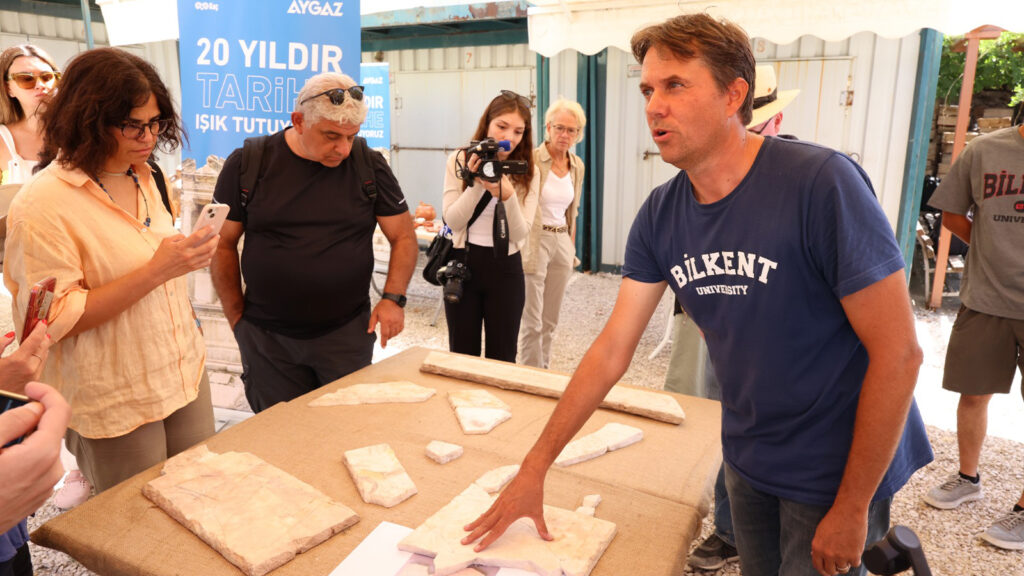
Dr. Peter Talloen, Chair of Bilkent University’s Department of Archaeology and Director of the excavations, explained the Egyptianizing wall decoration revealed by the new finds. Because examples of such iconography outside Egypt are unknown, this scene sheds unique light on the decorative programs of sanctuaries devoted to Egyptian deities beyond the Nile lands.
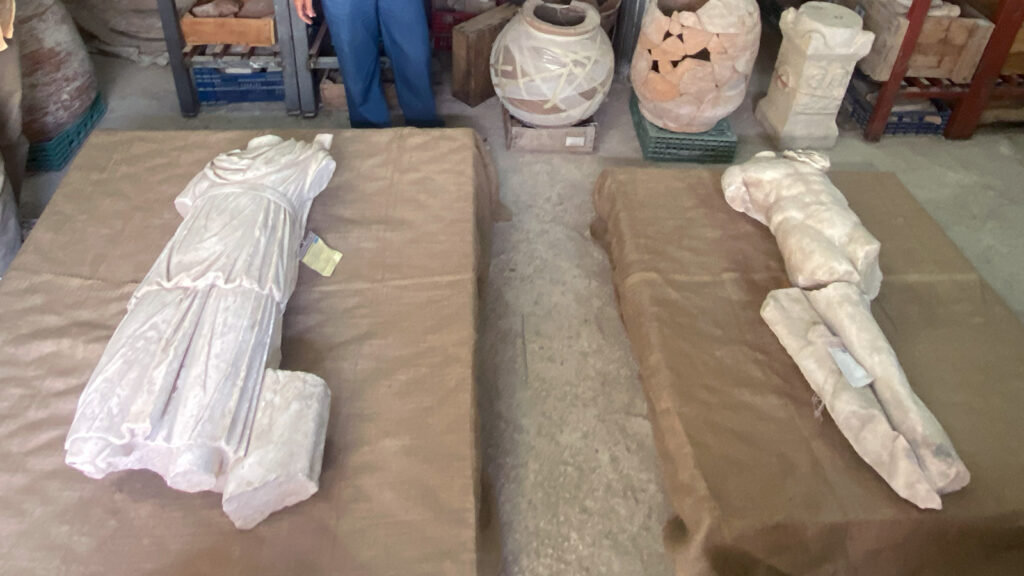
Another major discovery comes from recent excavations at a fountain located at the junction where the Southeast Street meets the Upper Agora. There, archaeologists found two life-size marble statues — one of the moon god Men and one of Hermes. The Men statue, placed in front of the fountain, depicts the Anatolian moon god with a crescent behind his shoulders and wearing eastern dress: tunic, trousers, cloak and a Phrygian cap. Stylistic analysis dates this piece to the mid-to-late 2nd century CE, and it appears to be the oldest full-length marble depiction of Men known to survive.
The Hermes statue, found on the street leading to the Gymnasium immediately behind the fountain, is depicted nude except for a chlamys draped over his left shoulder and arm. Although the surface shows alterations from the Christian period, its pose, proportions, and drapery place it stylistically in the mid-to-late 2nd century CE, with typological parallels in Perge, Corinth, Side, and Baiae. Together, the Men and Hermes statues illustrate how local cultic traditions and broader Greco-Roman sculptural types were integrated into Sagalassos’s urban and religious fabric.
2025 also marks 20 years of continuous sponsorship by Aygaz of the Sagalassos excavations, highlighting the company’s long-term commitment to preserving Turkey’s cultural heritage. Aygaz General Manager Melih Poyraz said, “For the past twenty years, each excavation season at Sagalassos has continued to yield new discoveries — a truly gratifying development that brings knowledge buried deep in history into the present day.”
Dr. Talloen noted that: “As Excavation Director I can comfortably say that Sagalassos is one of the best-preserved settlements of the Mediterranean, providing an unequalled window onto centuries of urban life, culture and resilience. Its extraordinary state of preservation makes Sagalassos not only a place of scientific discovery but a cultural treasure of universal value.
Sources: T24; Aktüel Arkeologi