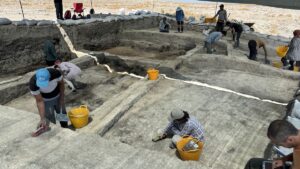
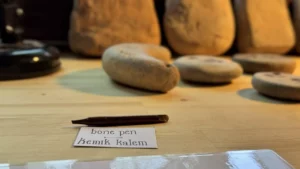
Excavations at Türkmen-Karahöyük, a strong candidate for the lost second capital of the Hittite Empire, have uncovered artifacts spanning millennia — including a 2,000-year-old bone pen, 4,000-year-old seals, arrowheads from 50 B.C., a 1,700-year-old die, and wheat and barley preserved for 3,000 years. Researchers also found fine ceramics, jewelry, perfume bottles, exotic fruits, and remains of monkeys once gifted by Egyptian rulers.
Dr. Michele Rüzgar Massa of Bilkent University’s Department of Archaeology highlighted the site’s role as a major political and trade hub, noting, “We see strong signs this may have been the Hittites’ second capital.” Co-dırector Dr. James Osborne of the University of Chicago’s Department of Middle Eastern Studies noted evidence of violent destruction, pointing to fire damage and arrowheads that suggest the city was attacked around 50 BCE, after which regional power shifted to Konya.
With its scale, longevity, and far-reaching connections—from Egypt to Cyprus and the Black Sea—Türkmen-Karahöyük is emerging as one of Turkey’s most important archaeological sites, offering new insights into the political and cultural landscapes of ancient Anatolia.
Sources: TRT Haber; Hürriyet Daily News; Hürriyet